Twitch · Concept · Fall 2026
Community Climb
A redesign of Twitch's Hype Train as a planned stream segment. Chat climbs toward goals the streamer sets, every goal unlocks a challenge she performs live, and everyone who helped keeps a reward the community drew itself.
Problem
The Hype Train drives more than a third of viewer spending, and it feels stale.
The brief put us on Twitch's Monetization team. A Hype Train is a timed rush of support: viewers buy Subs, Bits and Gift Subs together to level up a train and unlock rewards, mostly emotes. Twitch's mission is to create belonging, and it wanted more new and returning spenders on mobile, where new users were not joining in.
The people we talked to described it the same way from both sides. It blends in, and on mobile it is hard to find at all. The rewards are thin. It can feel like begging, which a streamer and a viewer both said. And money is the only way to take part, so everyone who doesn't pay is a spectator.
We started from two questions.What makes people feel they belong?Why do people donate?
Research
Each reason to donate turned out to be a reason to belong.
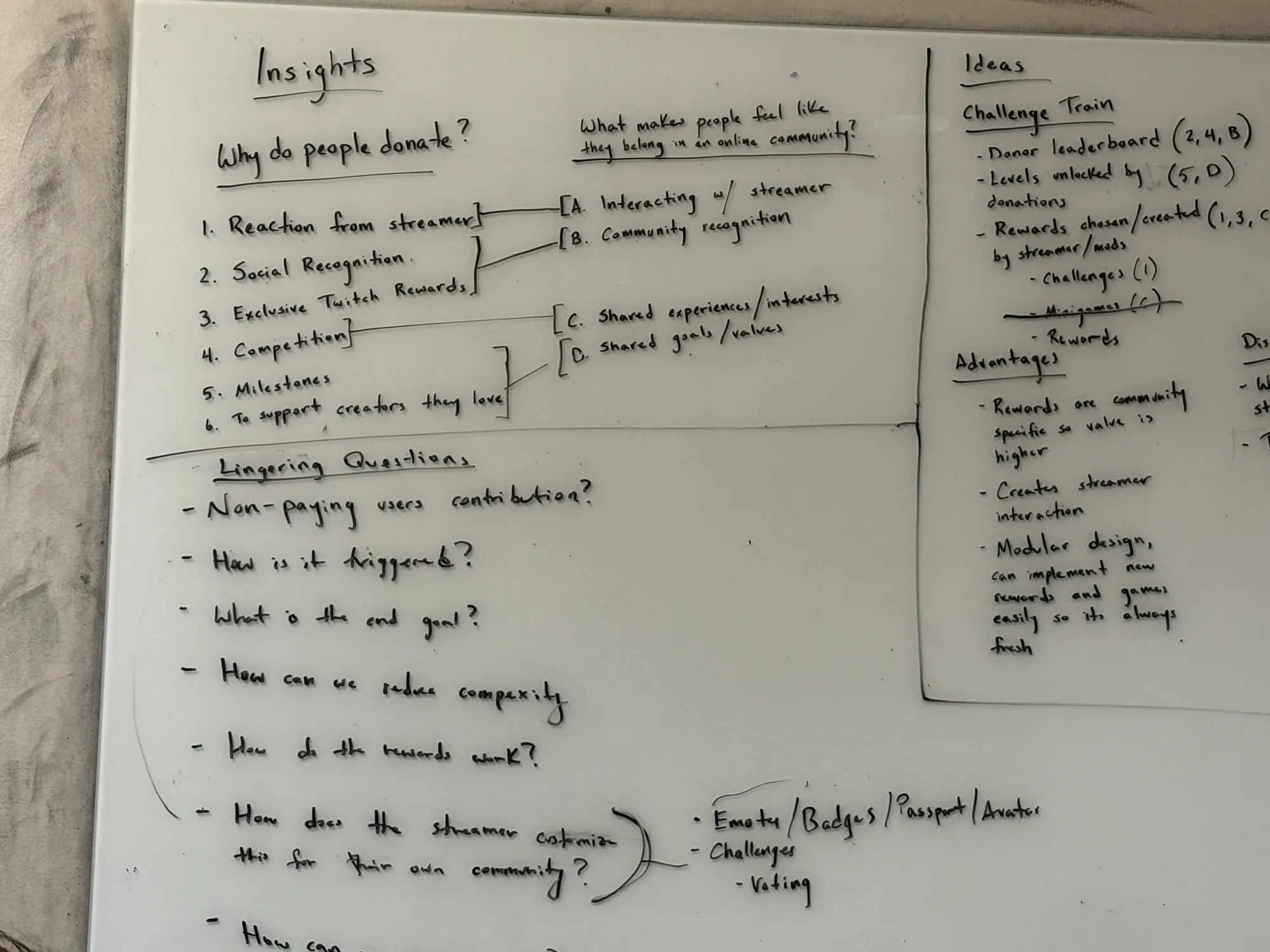
We interviewed viewers and streamers, ran a short survey, and read what people who donate say about it themselves. What we heard sorted into two sets of insights: six reasons people donate, and four things that make someone feel they belong in a chat.
Why people donate
- A reaction from the streamer. A donation gets read out, a joke lands, kind words get seen.
- Social recognition. Being seen by the rest of chat.
- Exclusive rewards. Badges, emotes and drops you can't get anywhere else.
- Competition. The telethon instinct to be the top supporter.
- Milestones. A goal the whole stream is pushing toward.
- Supporting a creator they love.
What makes people feel they belong
- Interacting with the streamer.
- Community recognition.
- Shared experiences and interests, down to the channel's inside jokes.
- Shared goals and values.
Drawn on the whiteboard, the two lists lined up almost one to one. A reaction from the streamer is a way of interacting with her. Recognition and exclusive rewards are how a community sees its members. Milestones are a shared goal. People were not paying for objects. They were paying to be part of something.
People want to feel like a member, not a customer.
The reasons people gave for not spending mattered as much. Some had no money to spare. Some saw no value in it, and would rather play the same game with friends. Some felt the creator was already rich enough. One interviewee had joined a Rainbow Six community challenge only for a skin he couldn't get anywhere else, which is exclusivity doing exactly what it should.
What Works
The Hype Train already meets most of those needs, so we kept what works.
Checked against those insights, the existing feature did better than its reputation. It already marks big moments and gives a stream a shared goal. Three pieces carried most of that, and all three stayed.
Milestones · Shared goals
The shared meter
One bar the whole stream fills together. Milestones, and a goal everyone shares.
Milestones · Supporting creators
Levels to unlock
Steps along the way, so support adds up to something you can see.
Recognition · Competition
Top-supporter recognition
The people carrying the train get named in front of chat.
The Gaps
Three things the Hype Train misses, and all three are about who it belongs to.
Gap 1 of 3
The streamer is missing from their own Hype Train
It starts automatically when people spend. The streamer can only react afterward.
Gap 2 of 3
Its rewards don't belong to the community
Every channel unlocks the same kind of generic reward.
Gap 3 of 3
Nobody knows it's coming
It appears without warning. You can't rally around a goal you didn't know existed.
Solution
Community Climb: live challenges, fan-made rewards, and a climb planned ahead.
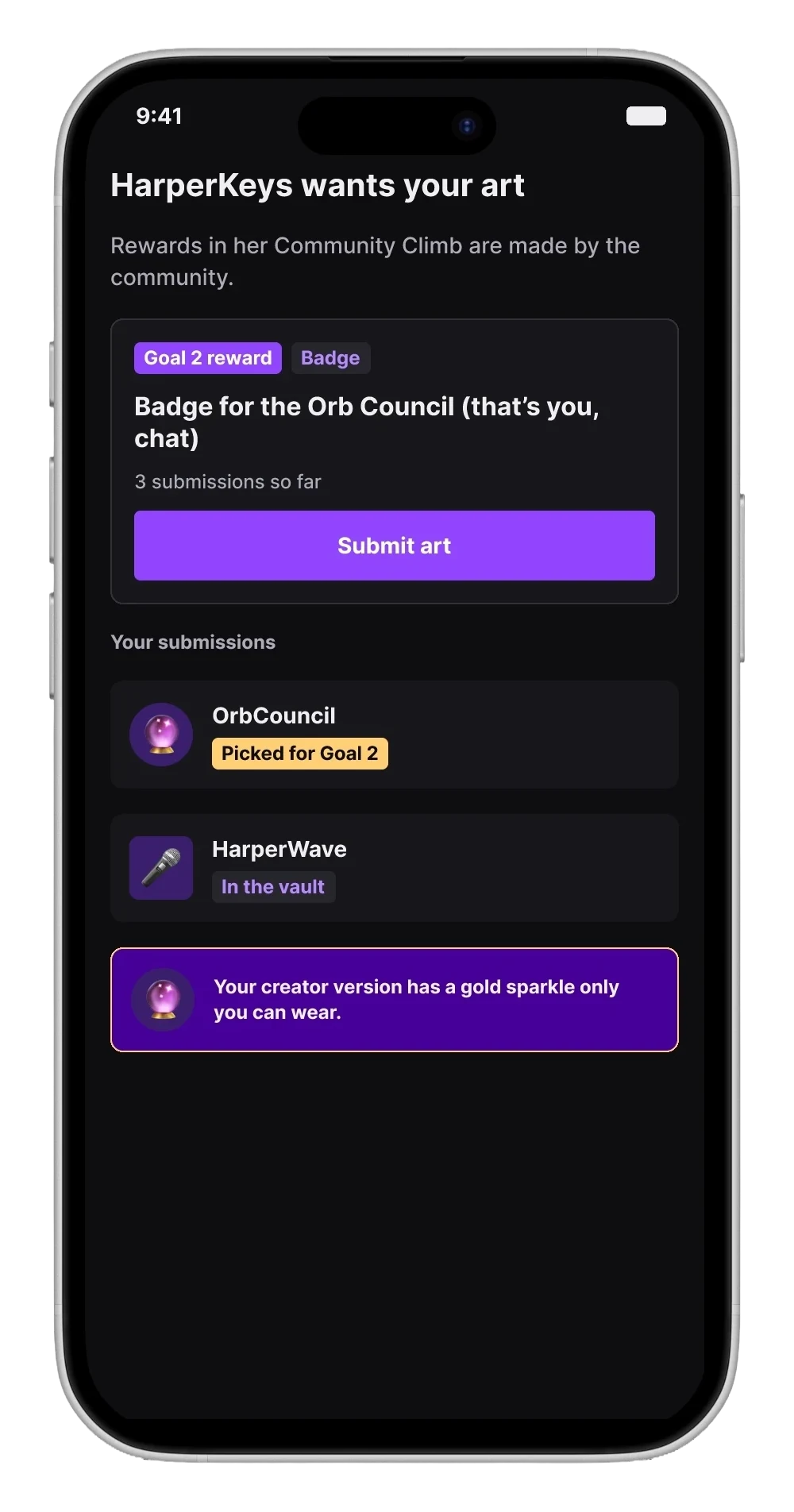
Each gap gets one answer. The streamer plans the climb, so chat can see it coming. Every goal on the way up is a pair: a challenge she performs live on stream, which puts her back in the moment, and a reward only the people who helped earn. And the rewards are drawn by fans. Artists submit art, mods shortlist it, the streamer picks, and the chosen artist gets the credit.
Fills gap 1
Live challenges
Every goal unlocks something the streamer does on stream, when it suits the stream.
Fills gap 2
Fan-made rewards
Emotes and badges about this channel, drawn by someone in its chat.
Fills gap 3
Planned ahead
The climb has a name, a time and a goal list before it starts.
The streamer we designed for
To keep every screen honest we made up one streamer and wrote her a profile. HarperKeys is 21, a musician who streams piano, guitar and singing, and her chat has a running joke: when she runs out of ideas, she consults the Orb of Knowledge, and the Orb is never wrong. Every goal, reward and line of chat in the proposal is written for her channel, so the design had to work for a real community's inside joke rather than a generic one.
The creator dashboard
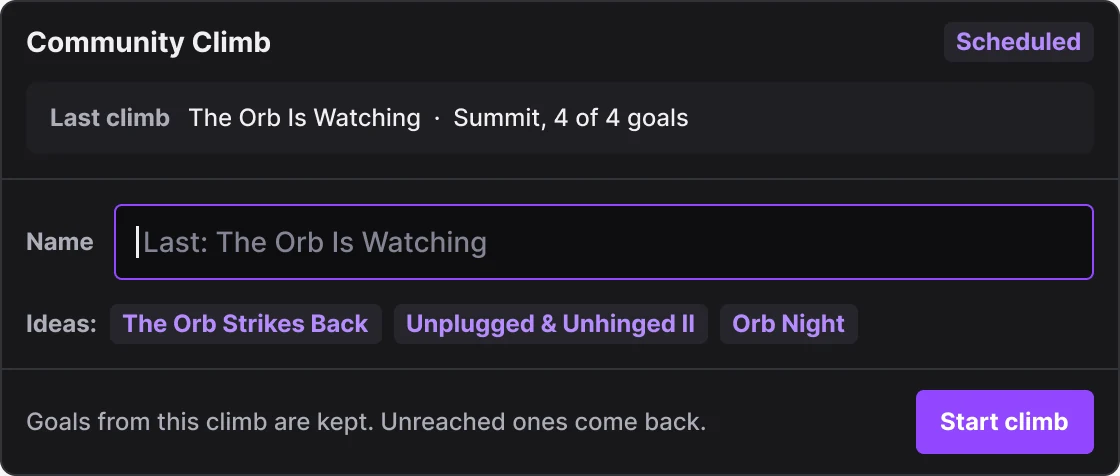
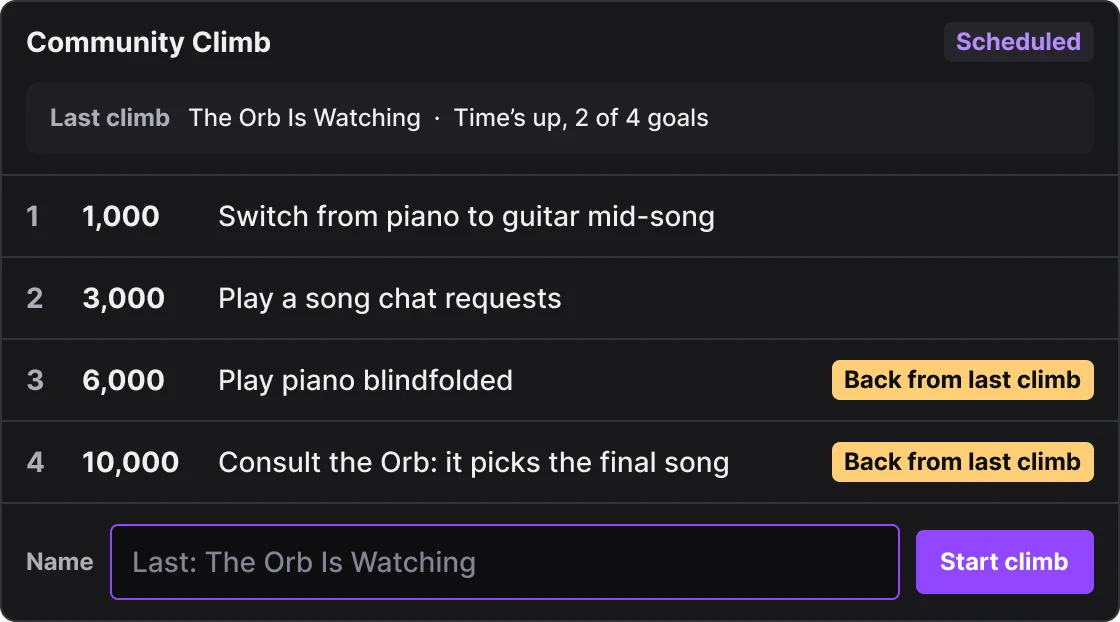
The climb starts on the streamer's side, which is the half of the Hype Train that did not exist before. Tonight's climb is called The Orb Is Watching, and HarperKeys builds it in her creator dashboard before she goes live.
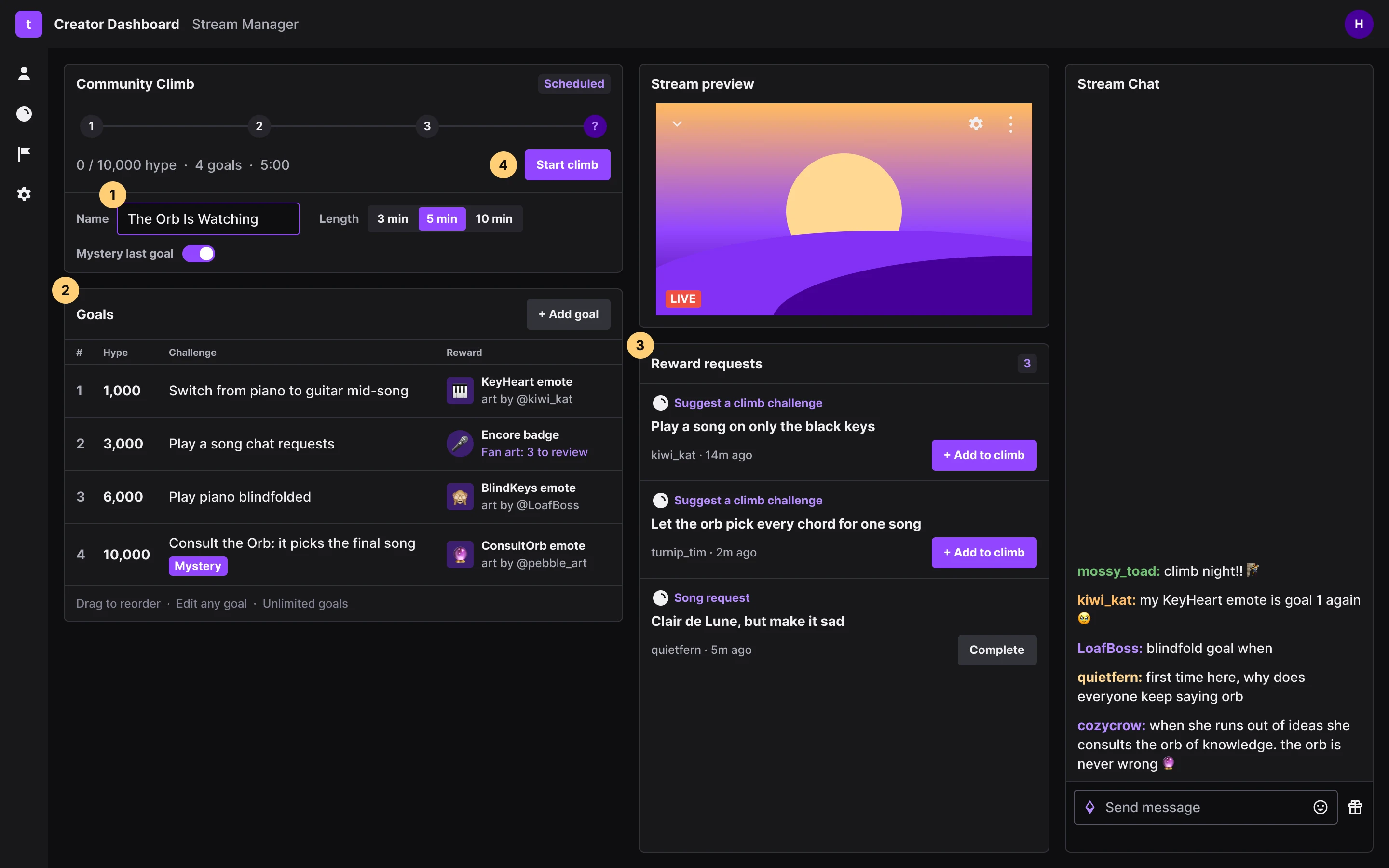
- 1 · Name it and size it. A name chat can rally around, a length of three, five or ten minutes, and a switch that keeps the last goal a mystery.
- 2 · Set the goals. Each one pairs a hype target with a challenge she will perform and a reward, credited to the fan who drew it. Goals can be reordered and edited, and there is no limit on how many.
- 3 · Take requests from chat. Viewers suggest challenges, and one click adds a suggestion to the climb. This is where the setup work gets shared with the community instead of landing on her.
- 4 · Start it when the stream is ready. Nothing triggers on its own. The climb begins when she presses Start climb, not when somebody happens to spend.
User Journey
One climb, from the first hint in chat to the summit.
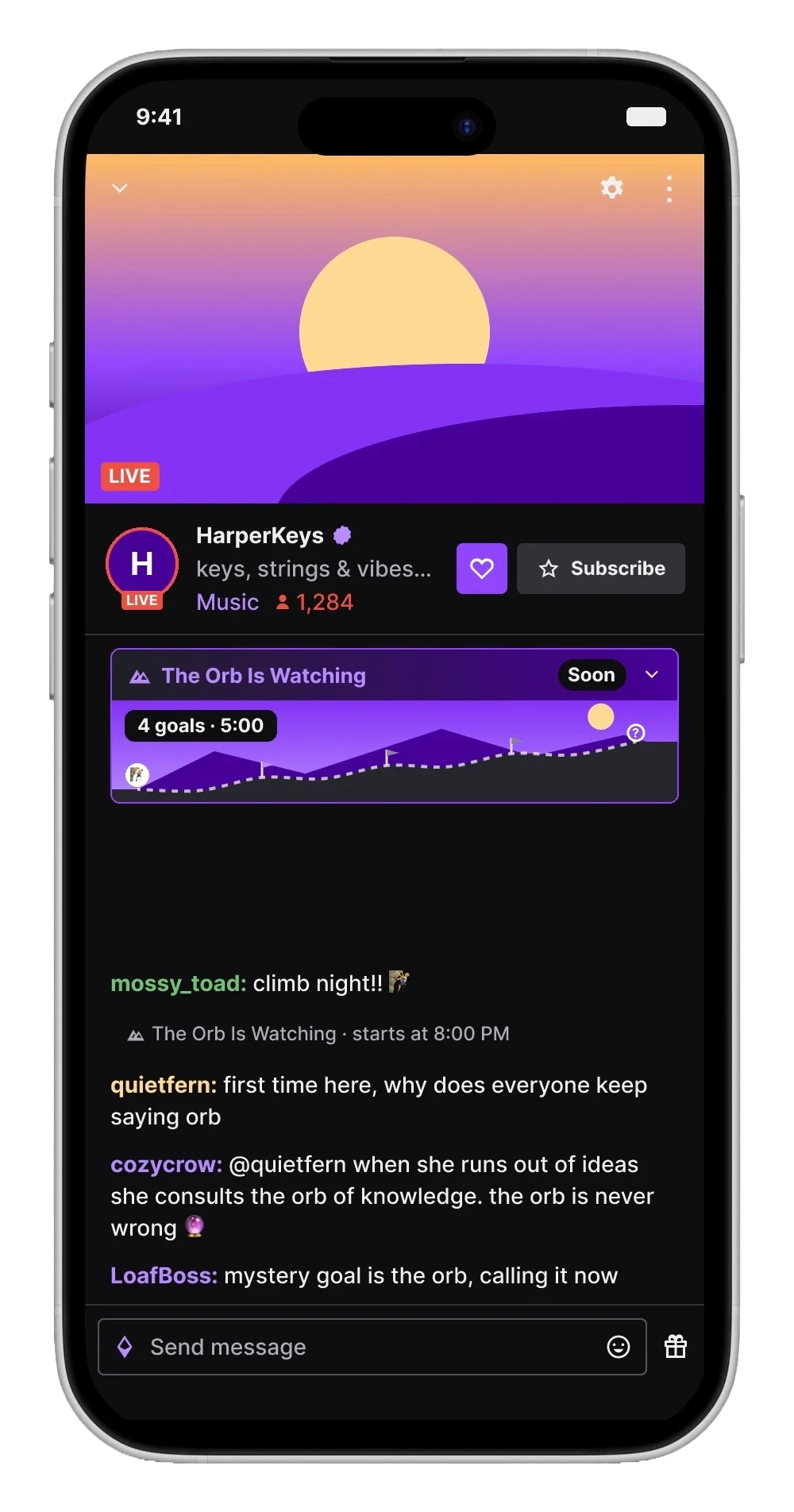
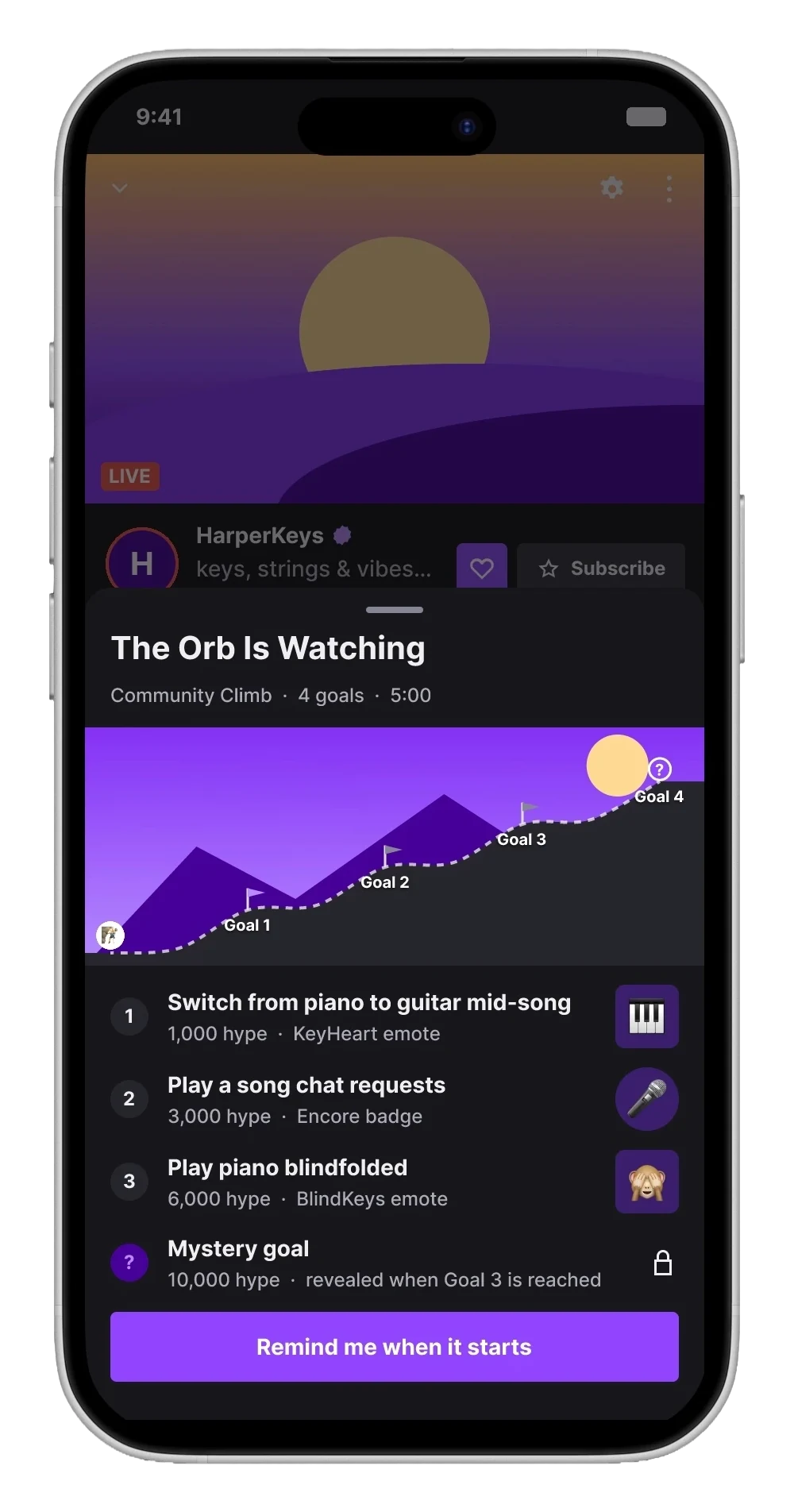
1 · Chat sees the climb coming before it starts
The climb sits above chat with a Soon tag hours before it begins. Opening it shows every goal and its reward, except the last, which stays a mystery. Newcomers ask why everyone keeps saying orb, and regulars explain. The joke becomes the way in.
2 · One shared bar
She starts the climb when the stream is ready, and there is one countdown for everyone. Every sub, gift sub and Bit moves the same bar up the mountain, and a flag plants at each goal.
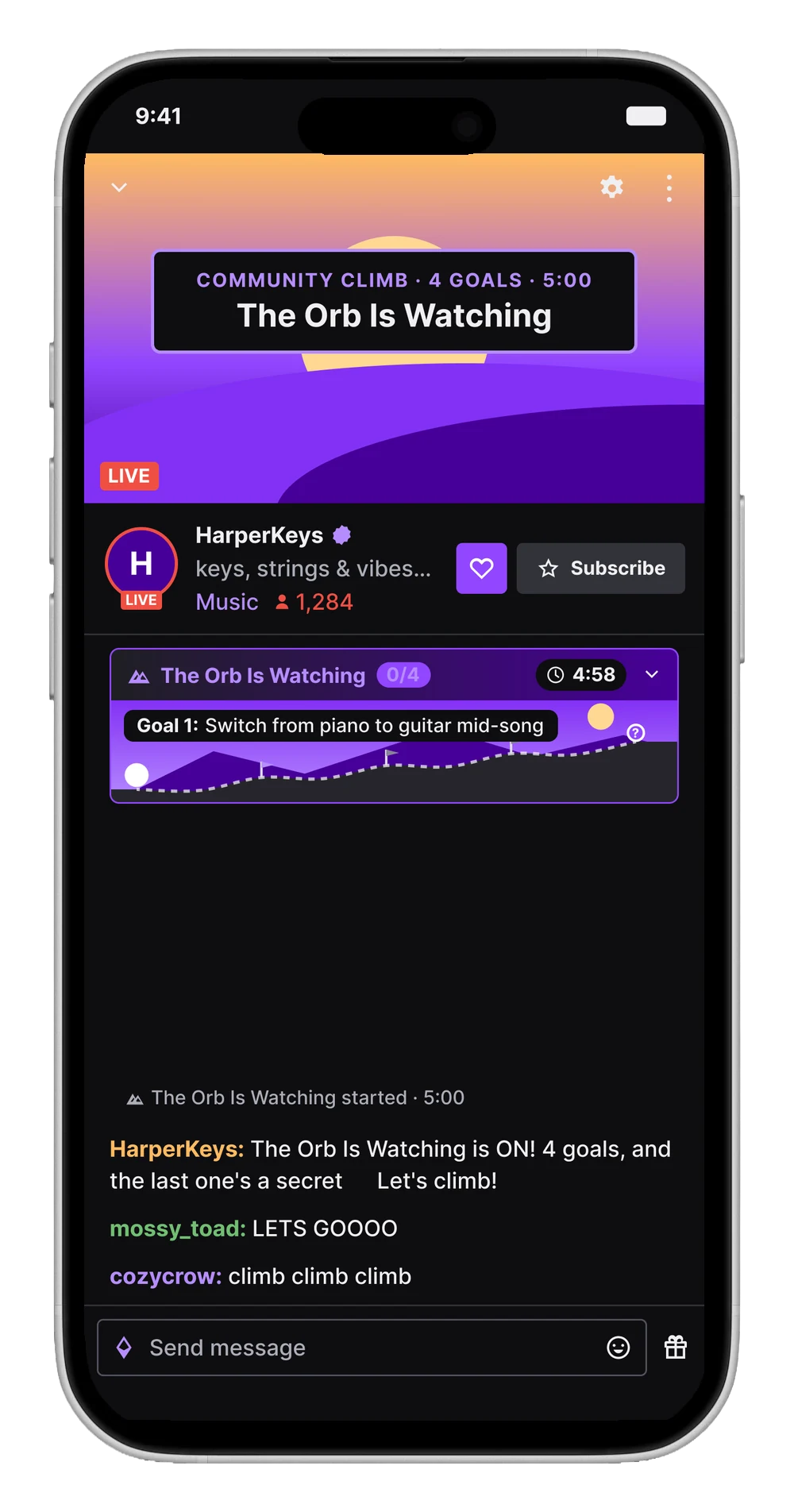
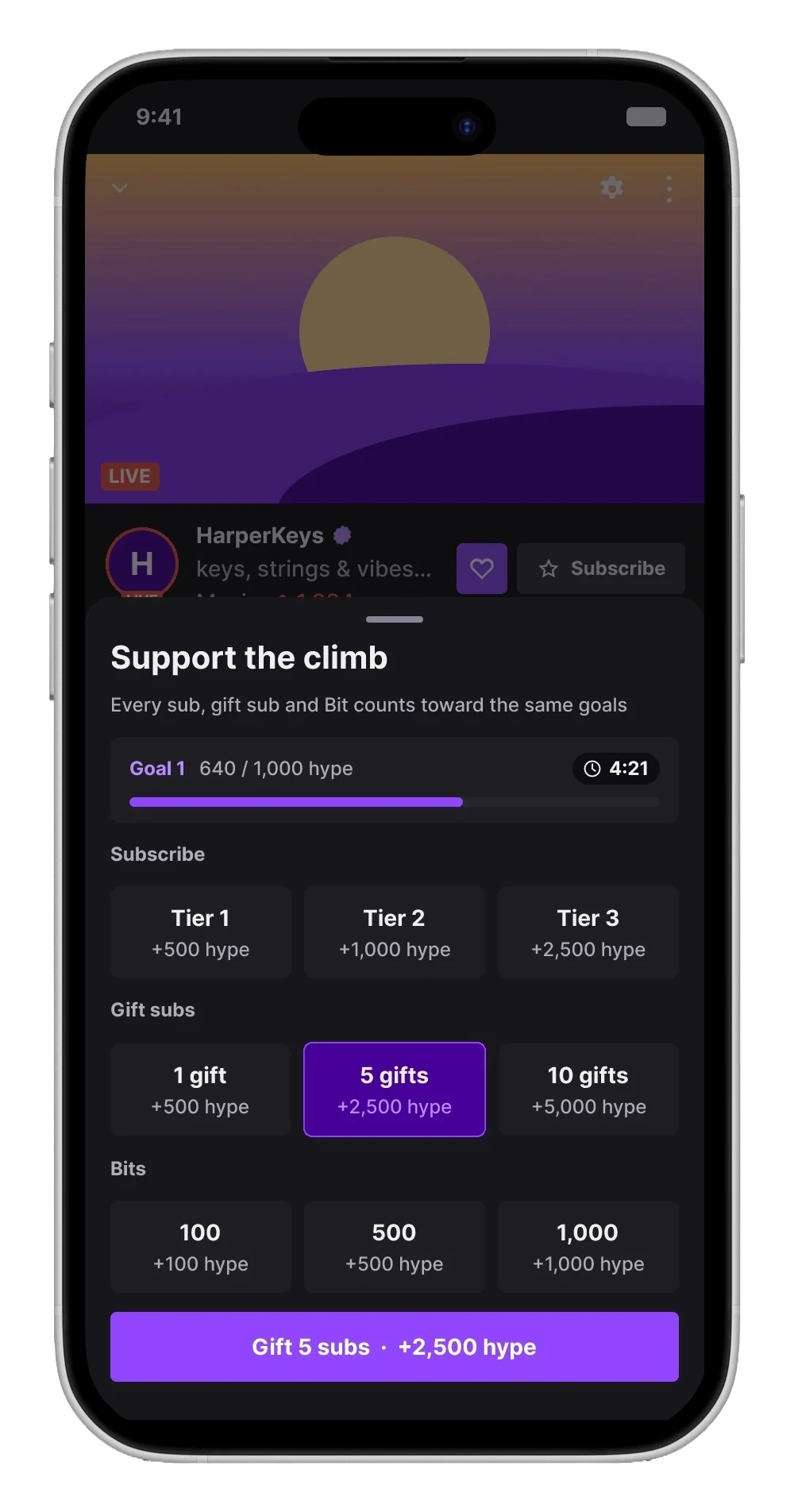
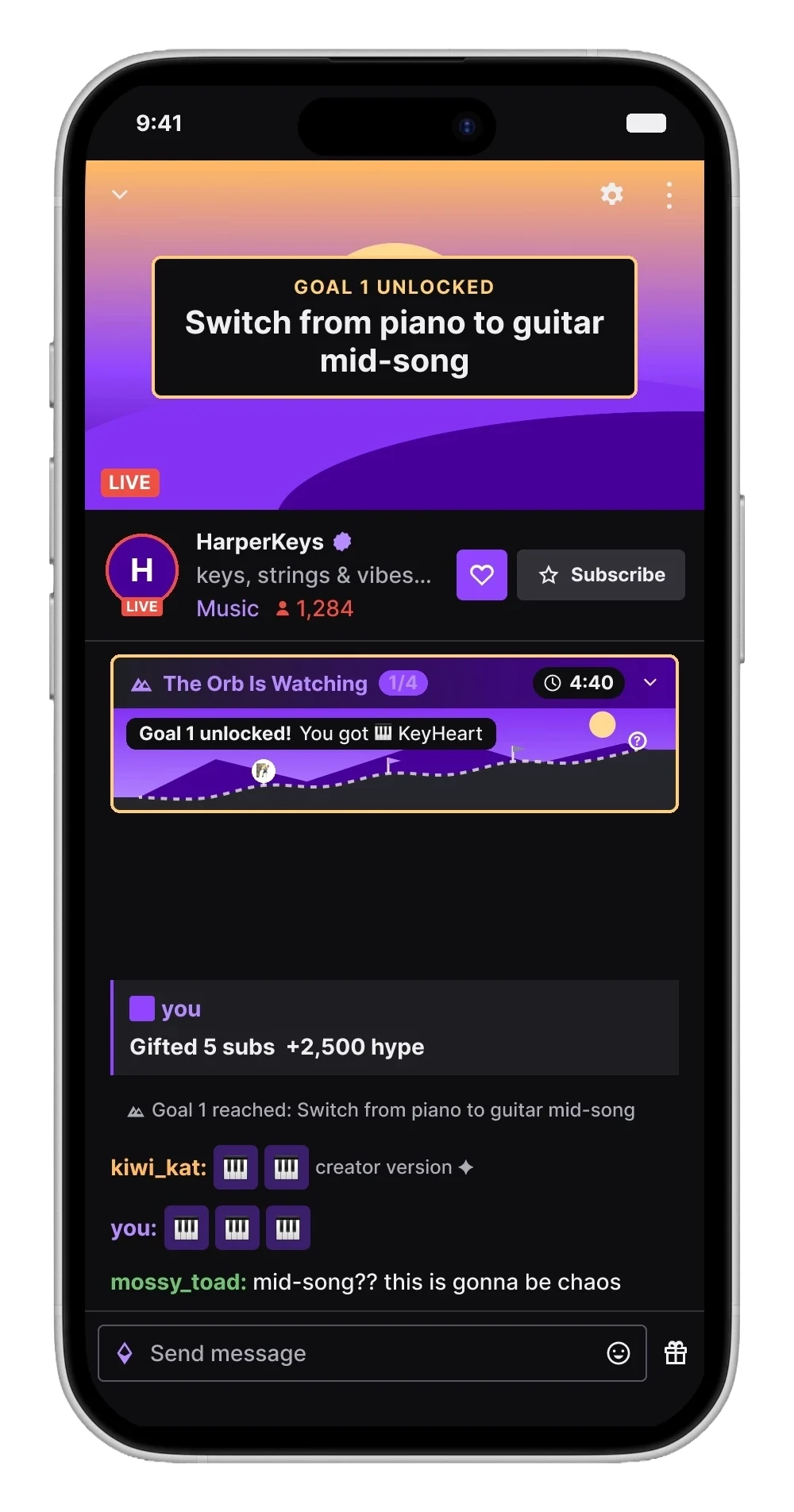
3 · She performs each challenge when it suits the stream
A reached goal waits for her. She starts the challenge from her dashboard when it fits the song, and the clock pauses while it is live, so the climb never punishes her for performing. If chat loses steam, it tells her to consult the Orb, and the mystery goal turns out to be exactly that: the Orb picks the final song.
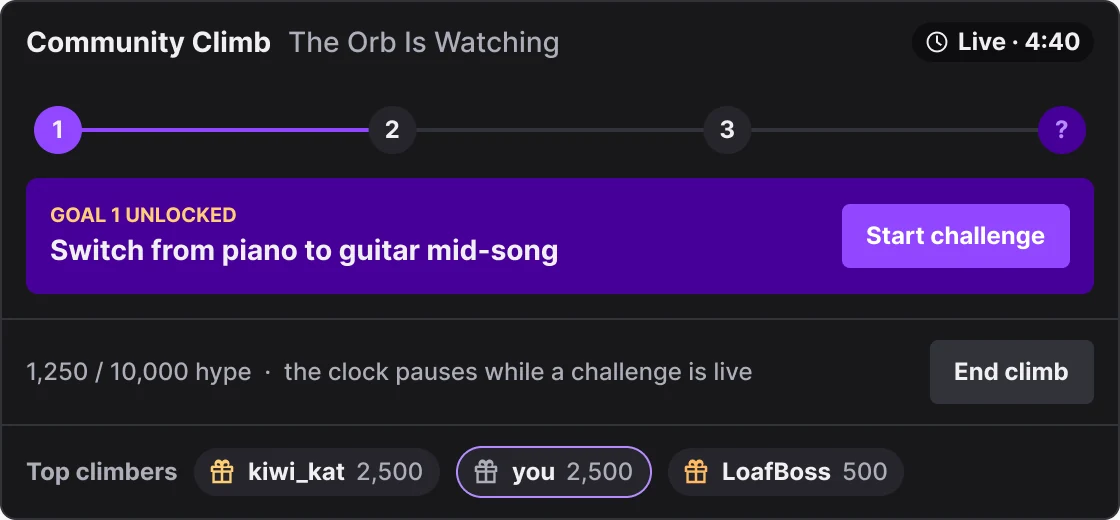
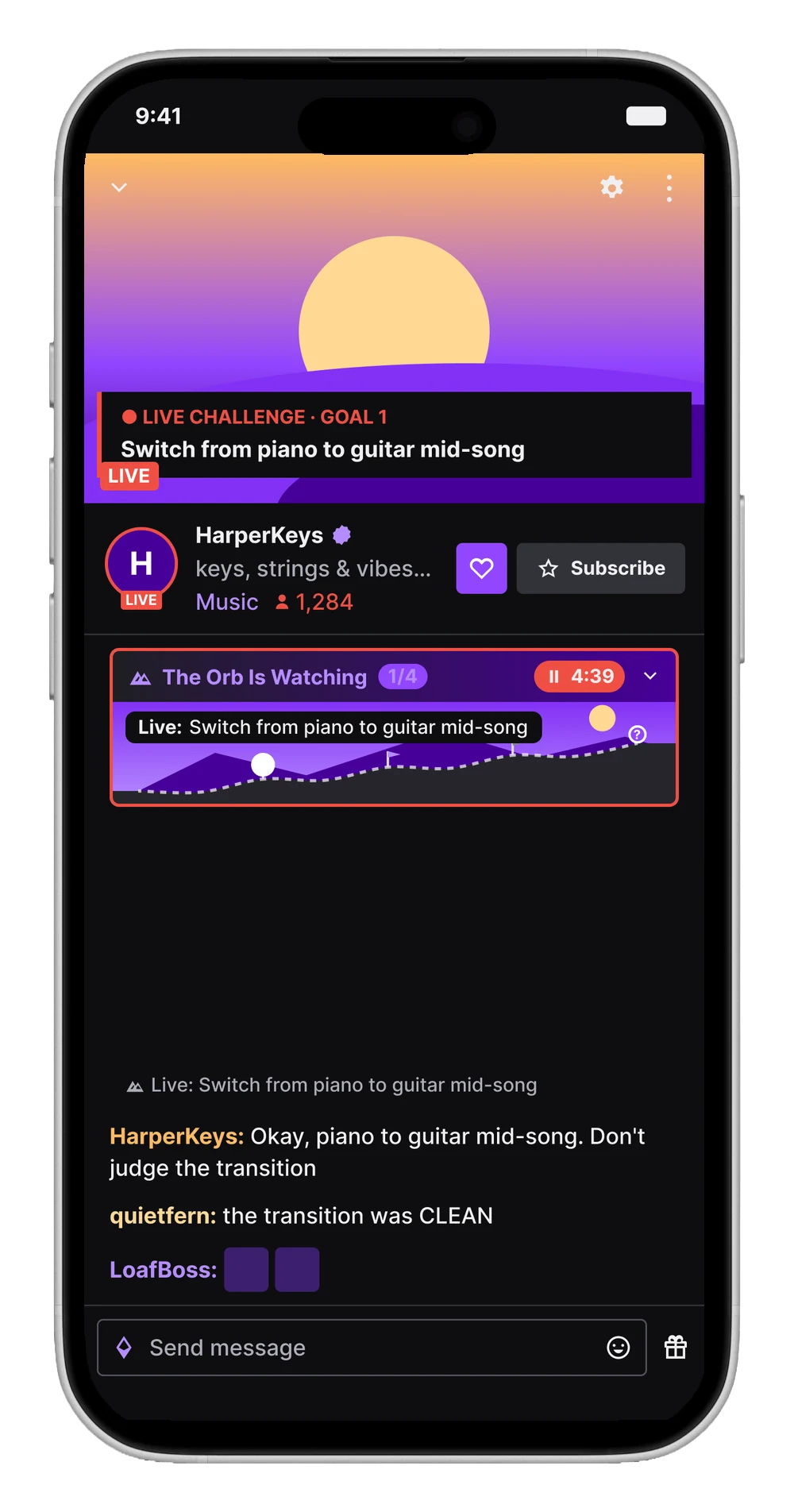
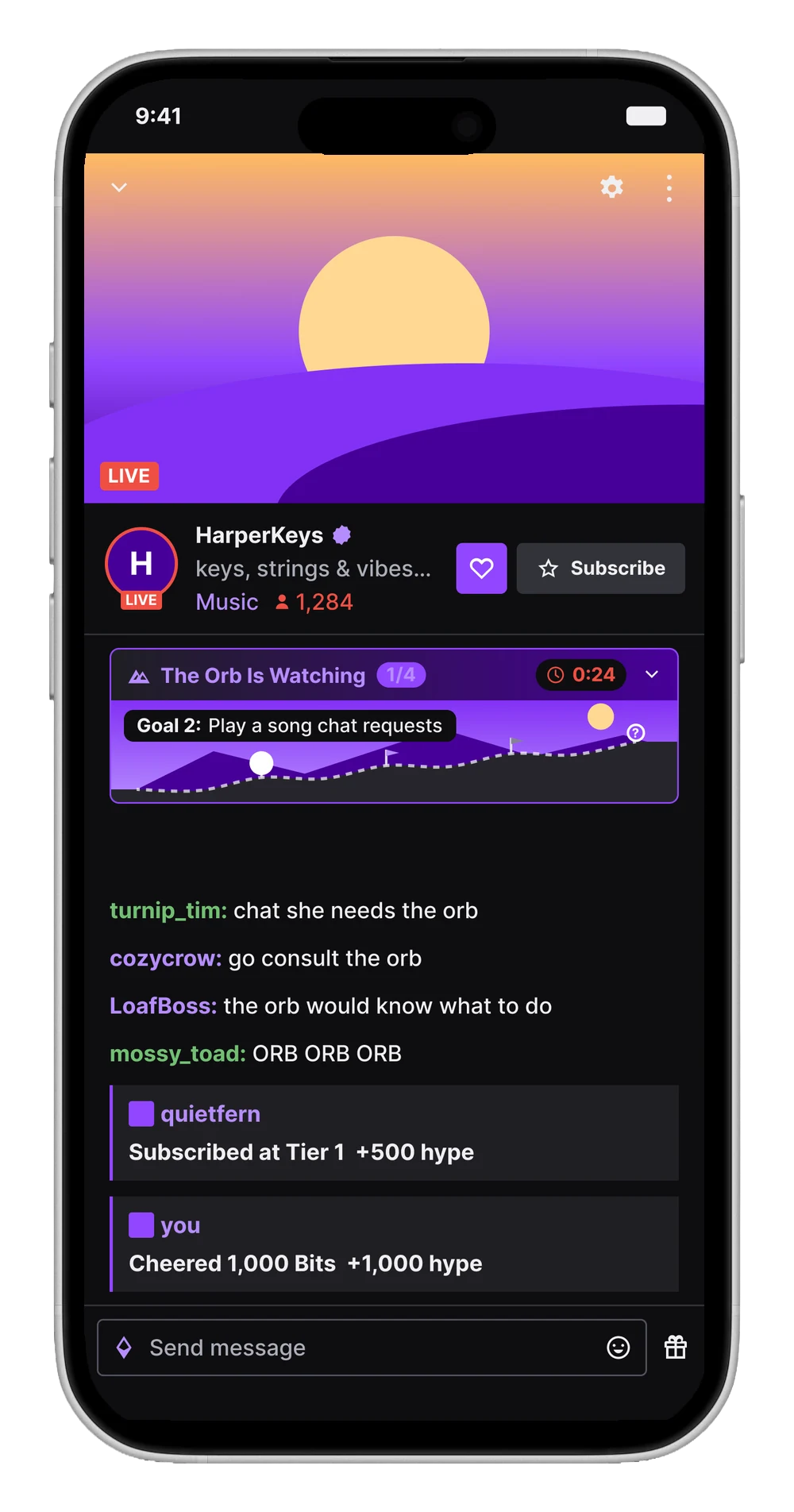
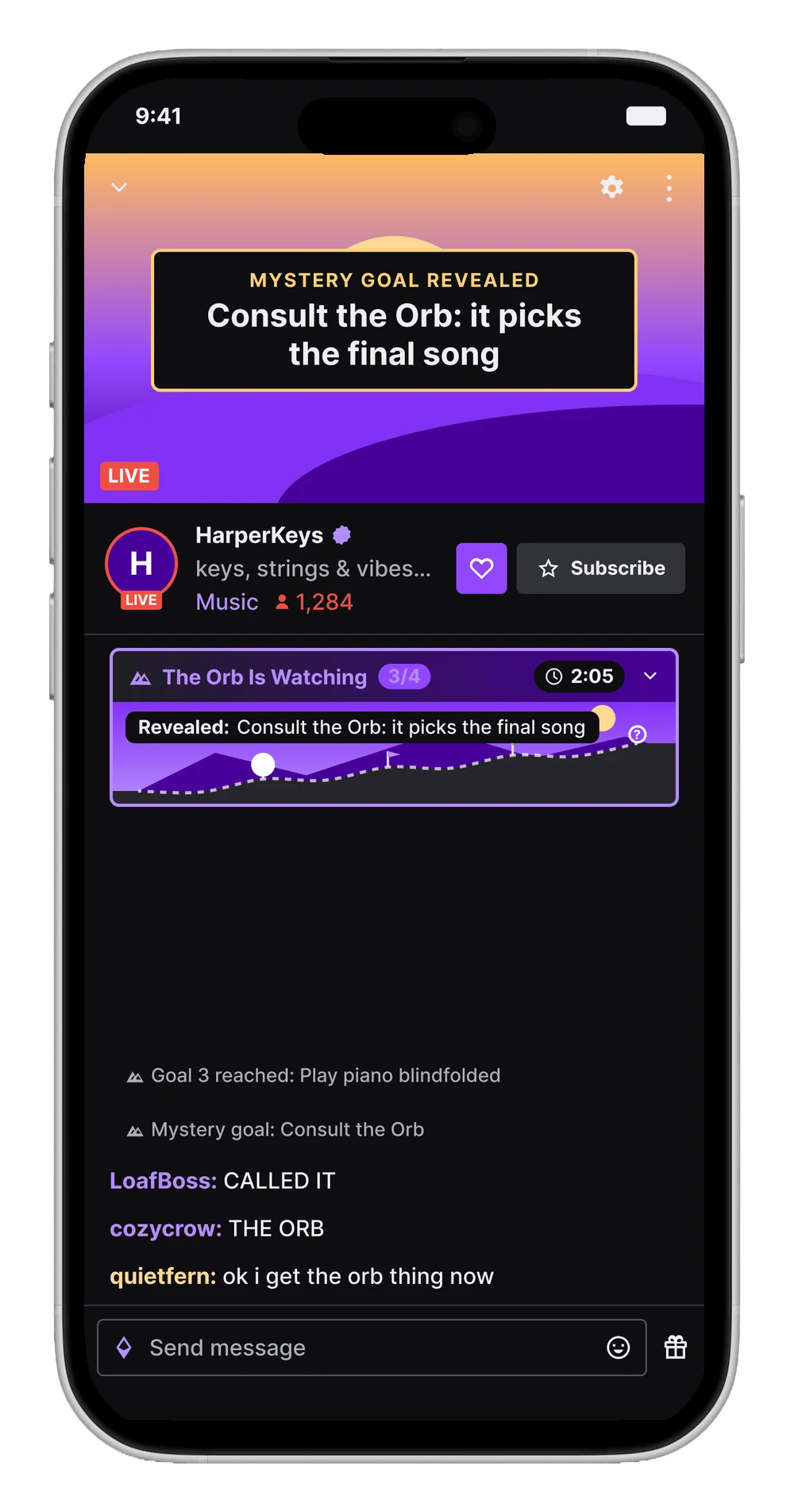
4 · At the summit, everyone who helped keeps every reward
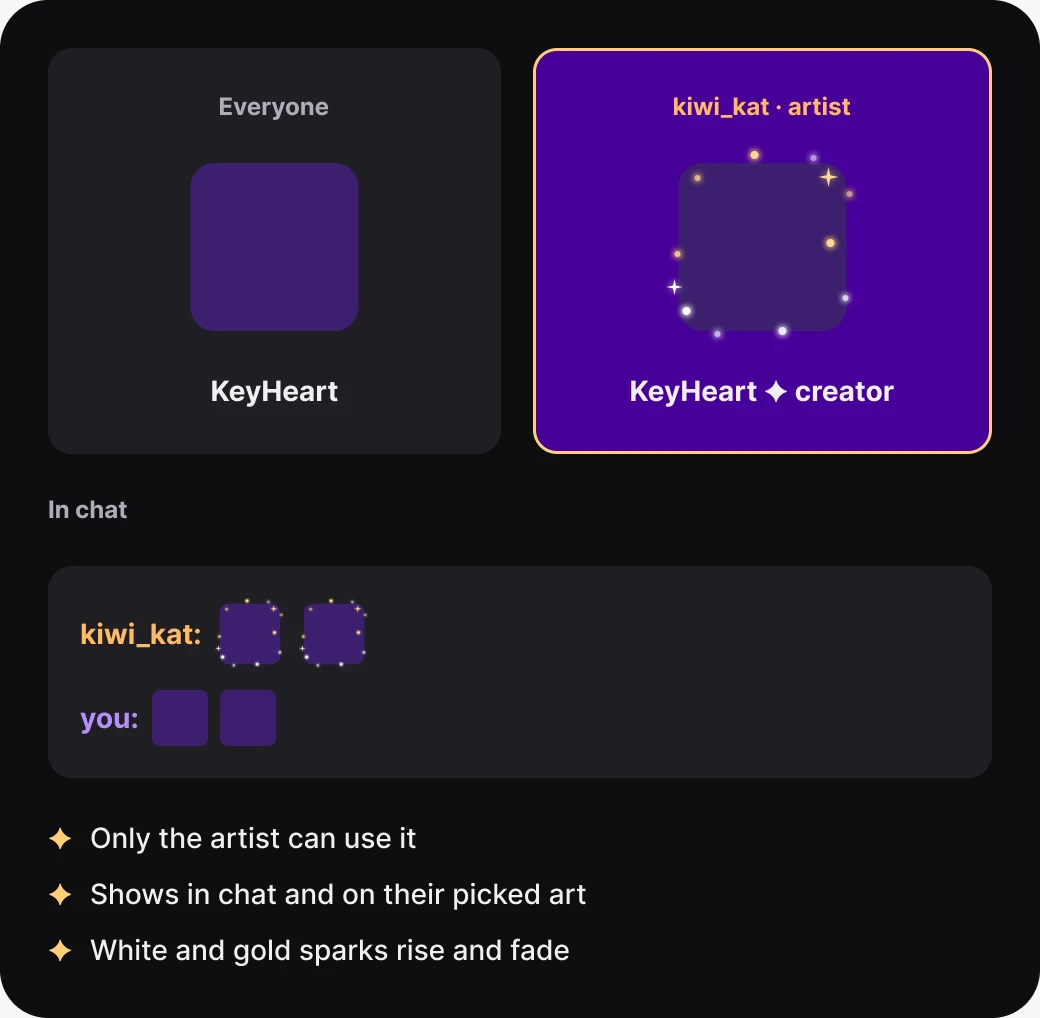
Reaching the top pays out every reward to everyone who contributed, the ConsultOrb emote included, and they keep them in every future stream. Then the next climb starts before this one is over: fans draw its rewards, mods shortlist them and she picks. The artist whose emote is chosen gets a creator sparkle on it that only they can use, so chat can see who made it.
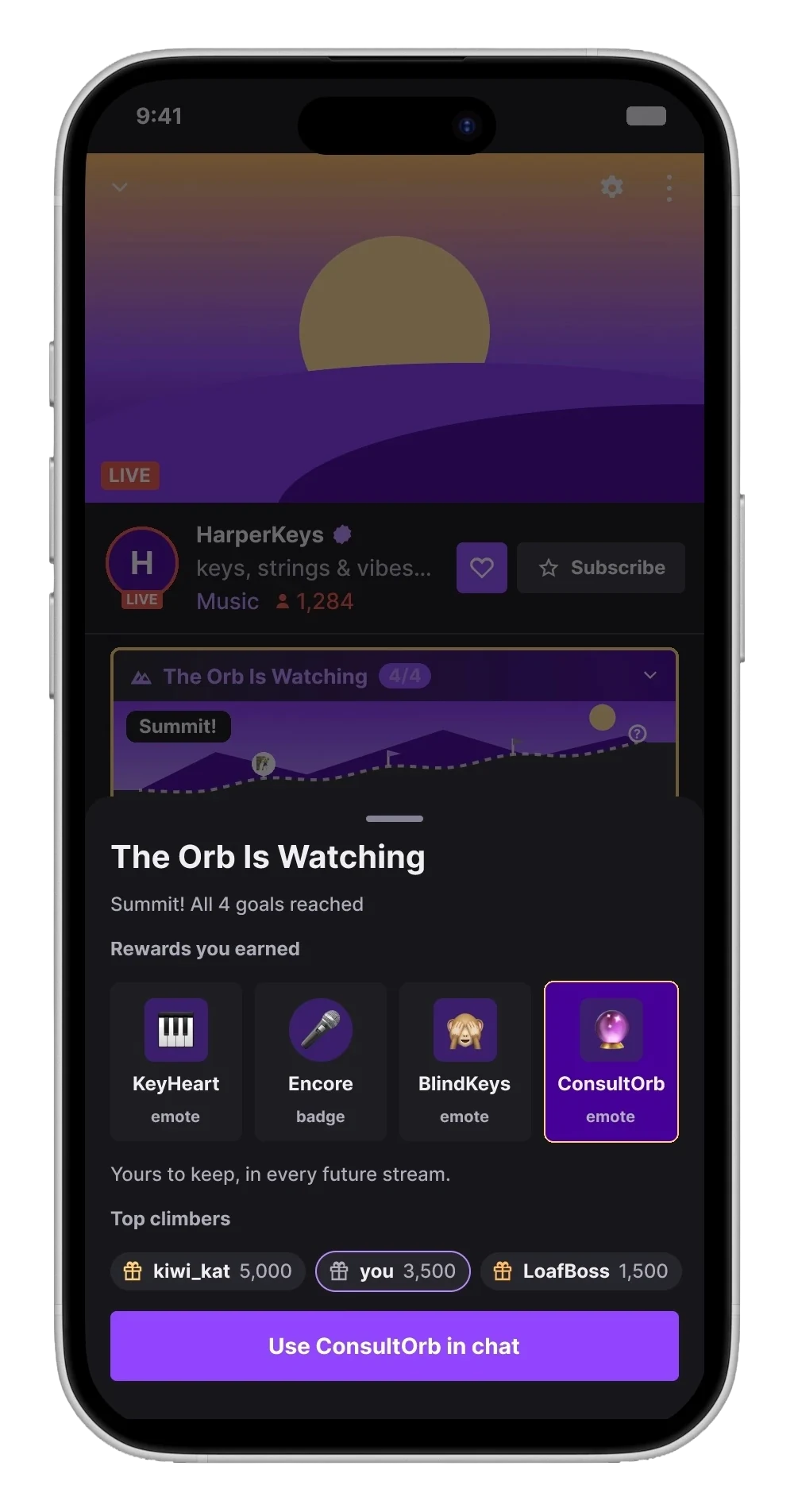
Recovery Path
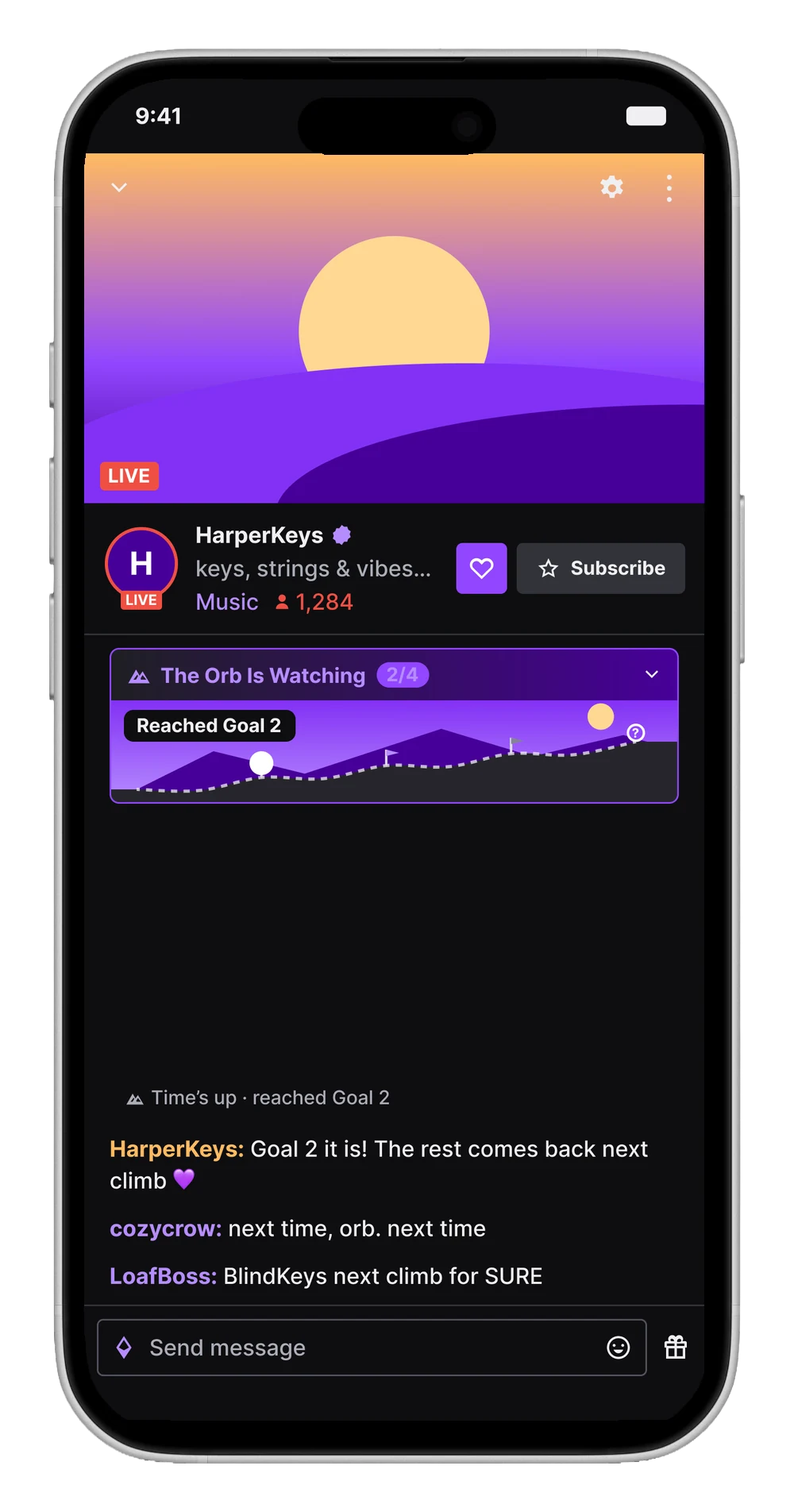
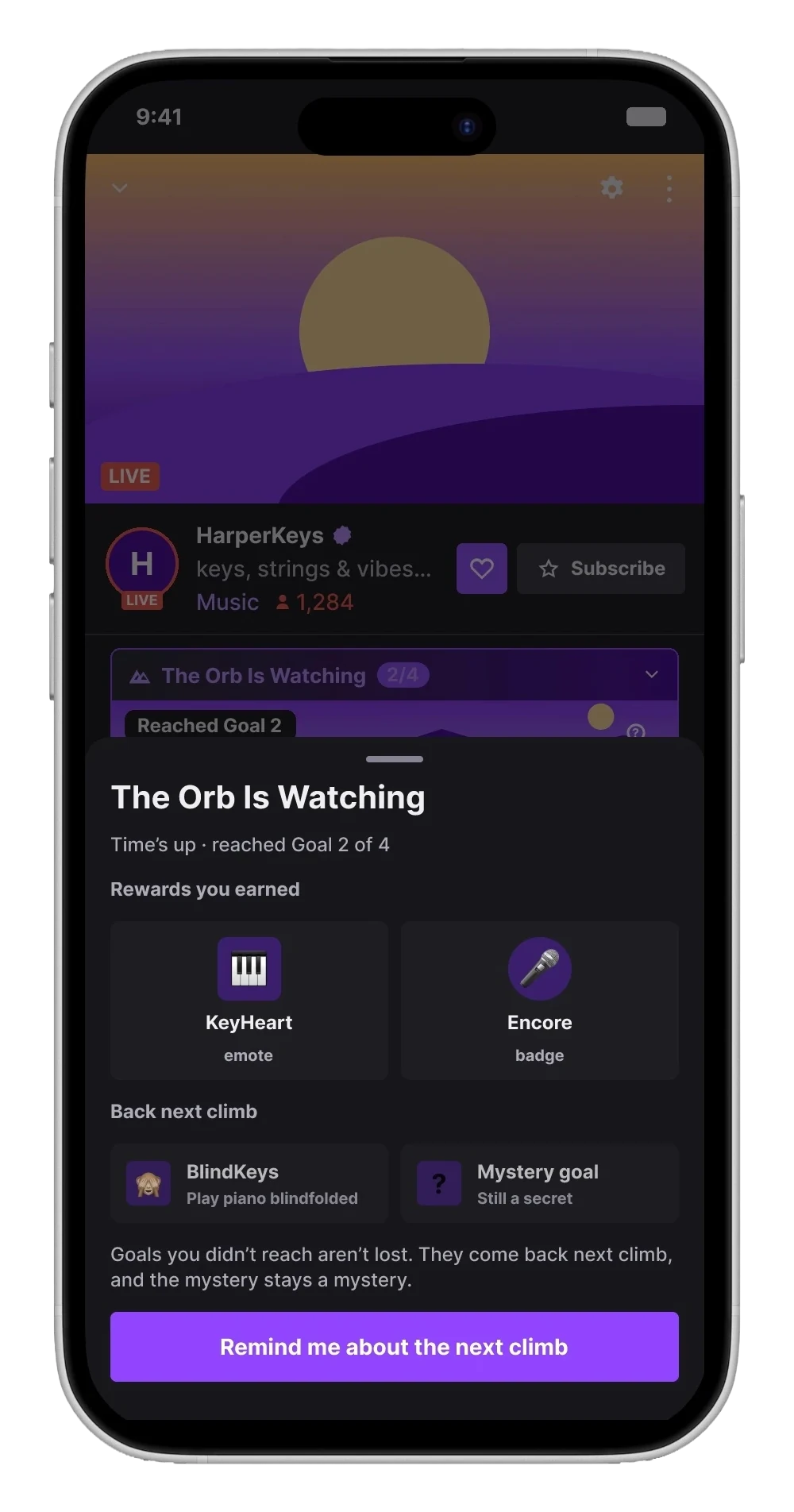
Sometimes time runs out at Goal 2, and the climb still pays out.
A climb that ends short of the summit should not feel like a failure the community paid for. Reached goals still pay out, the recap thanks the top climbers and the artists, and the goals nobody reached carry over to the next climb, mystery included.
Trade-offs
Giving streamers a creative tool also gives them more work.
The climb isn't a feature, it's a creative tool for streamers.
That framing has a cost, and it is the same one our instructor raised about the Challenge Train prototype: customization creates work. We designed for both of the risks that follow rather than hoping they would not come up.
Setting up a climb is more work for streamers
- The streamer can ask chat for suggestions, which arrive as requests she adds in one click.
- Last climb's goals can be copied over.
- Default rewards cover a streamer who doesn't want to commission any.
Fan art brings new risks
- Quality and stolen art.Mods shortlist, the streamer picks, and Twitch's emote review still applies.
- Fair pay for artists. Artists get credit and a Creator badge, and the sparkle makes the credit visible every time the emote is used.
Next Steps
Start with streamers, then launch with the biggest.
Now
Talk to streamers
The whole design leans on them being willing to plan a climb, so that comes first.
Near
Launch with big streamers
Channels with the community and the running jokes to make a climb land.
Next, then far
Grow it, then open it up
Expand what a climb can do, then open it to every streamer.
What we'd measure
- Donations during a climb, against a Hype Train on the same channel.
- Chat activity, since the point is people taking part, not only paying.
- Climb usage: whether streamers who run one run another.
These are what we would measure, not what we measured. This was a concept sprint, and the Figma proposal has not been in front of streamers yet.
Process
Ten concepts, four prototypes, and one direction built from what held up.
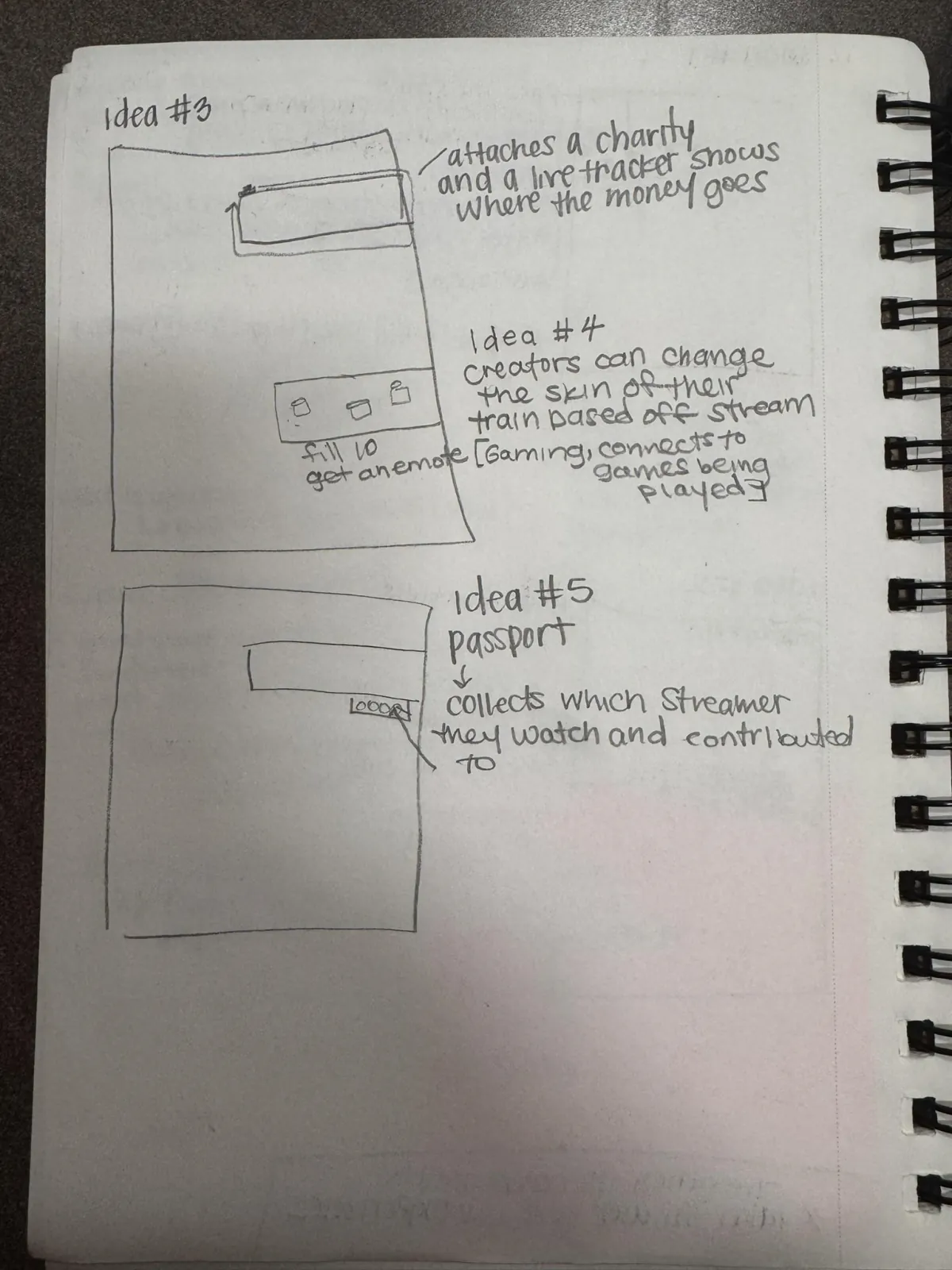
We sketched ten lo-fi concepts: Pass the Spark, Streamer's Choice, a Social Recognition Award, Avatar Unlock, Factions, Streamer vs Chat, Passport, Boss Battle, Challenge Train and a minigame feature. Each of us then vibecoded one in React, to find out how it felt to use and not only how it looked.
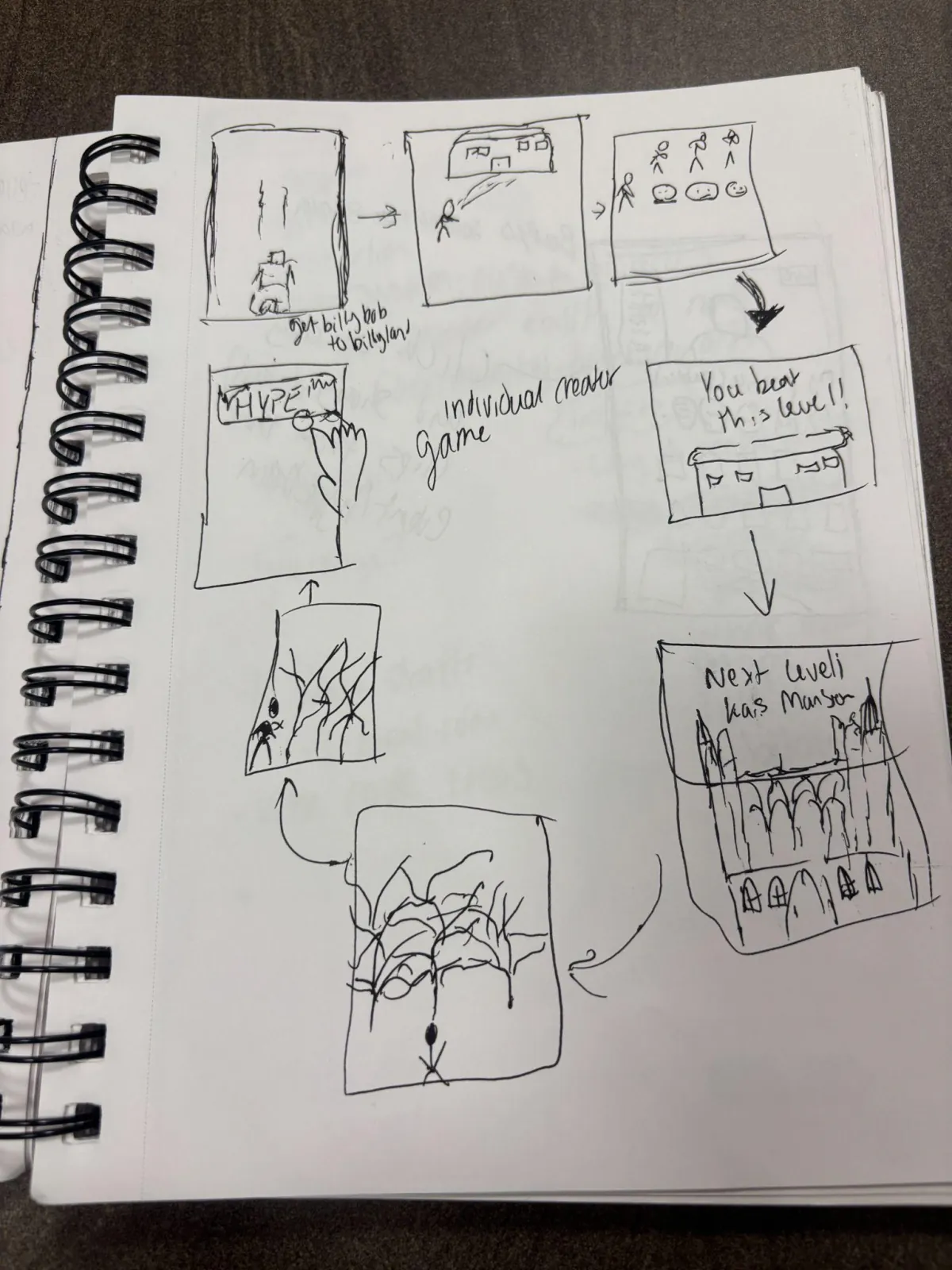
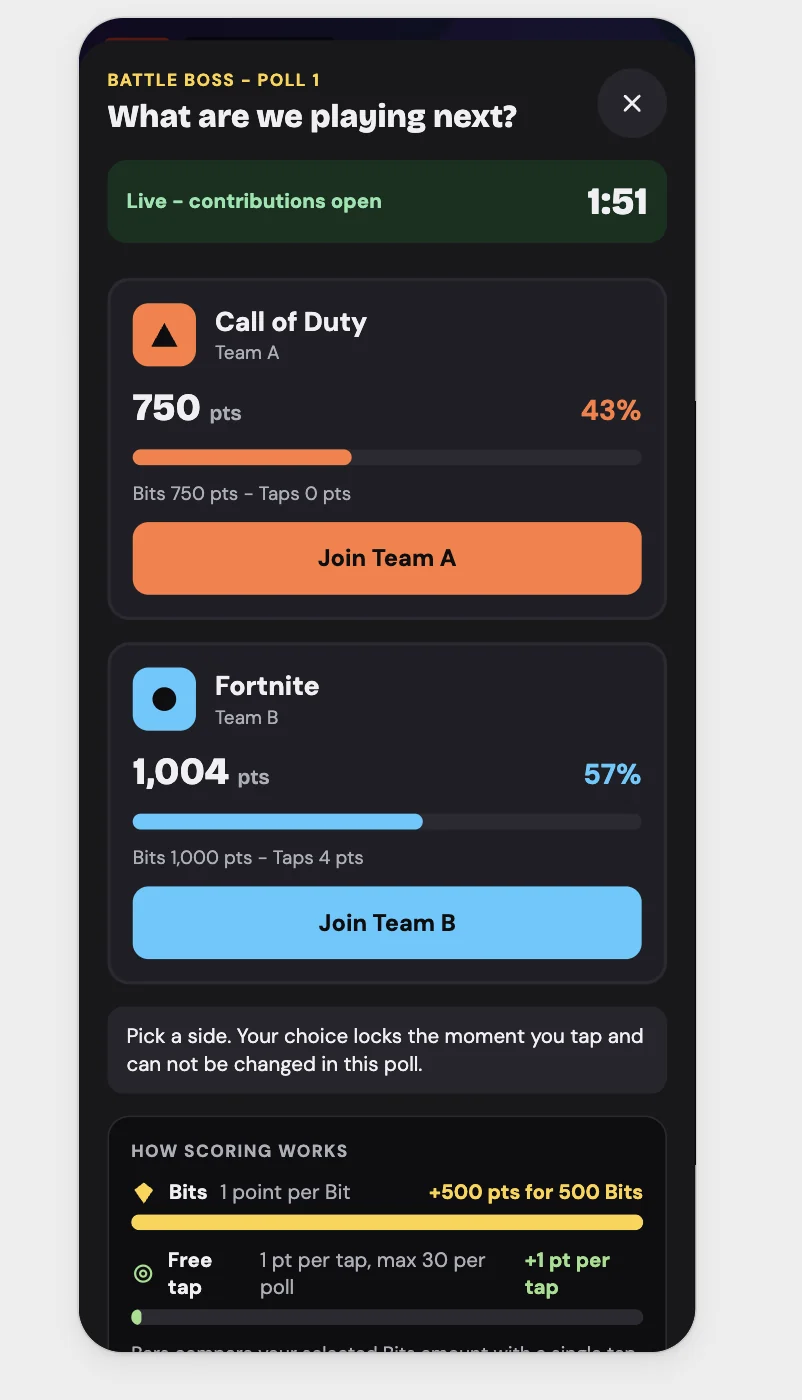
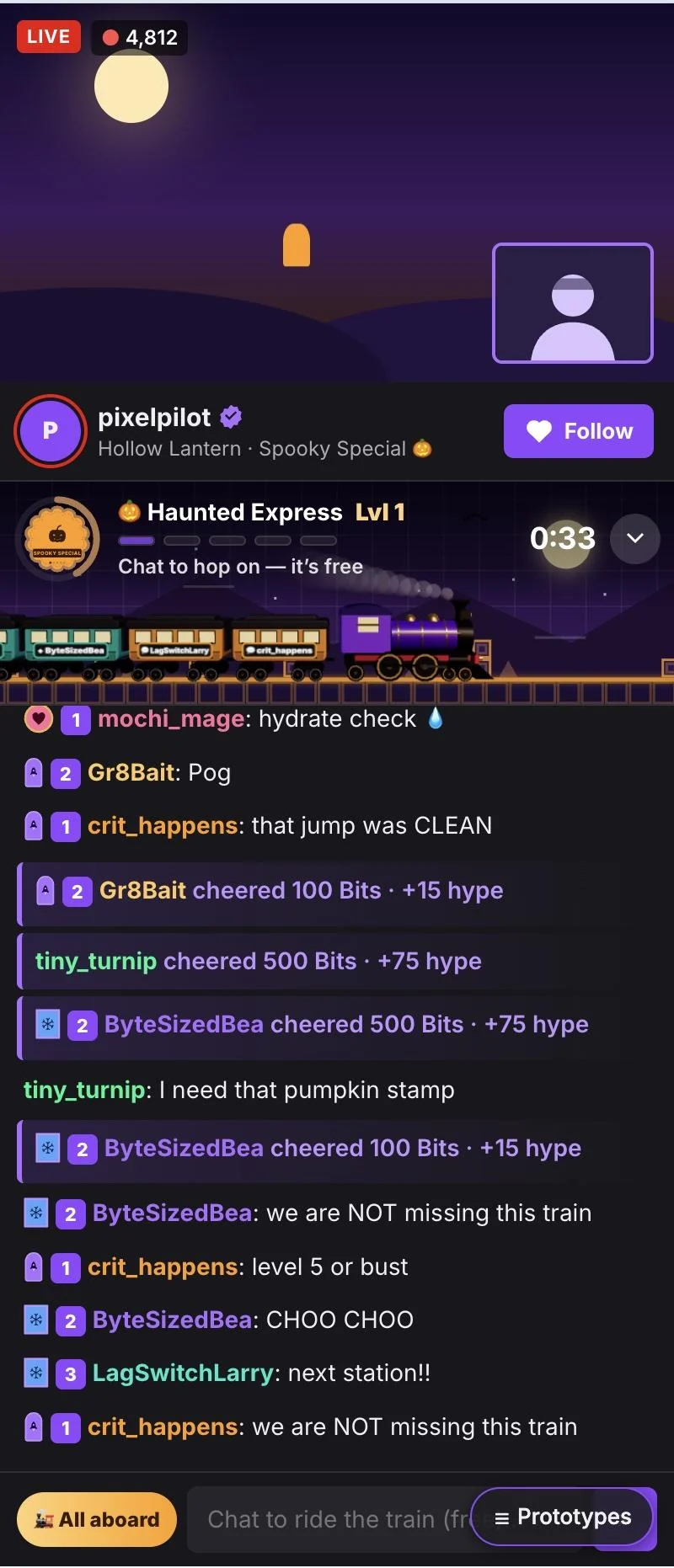
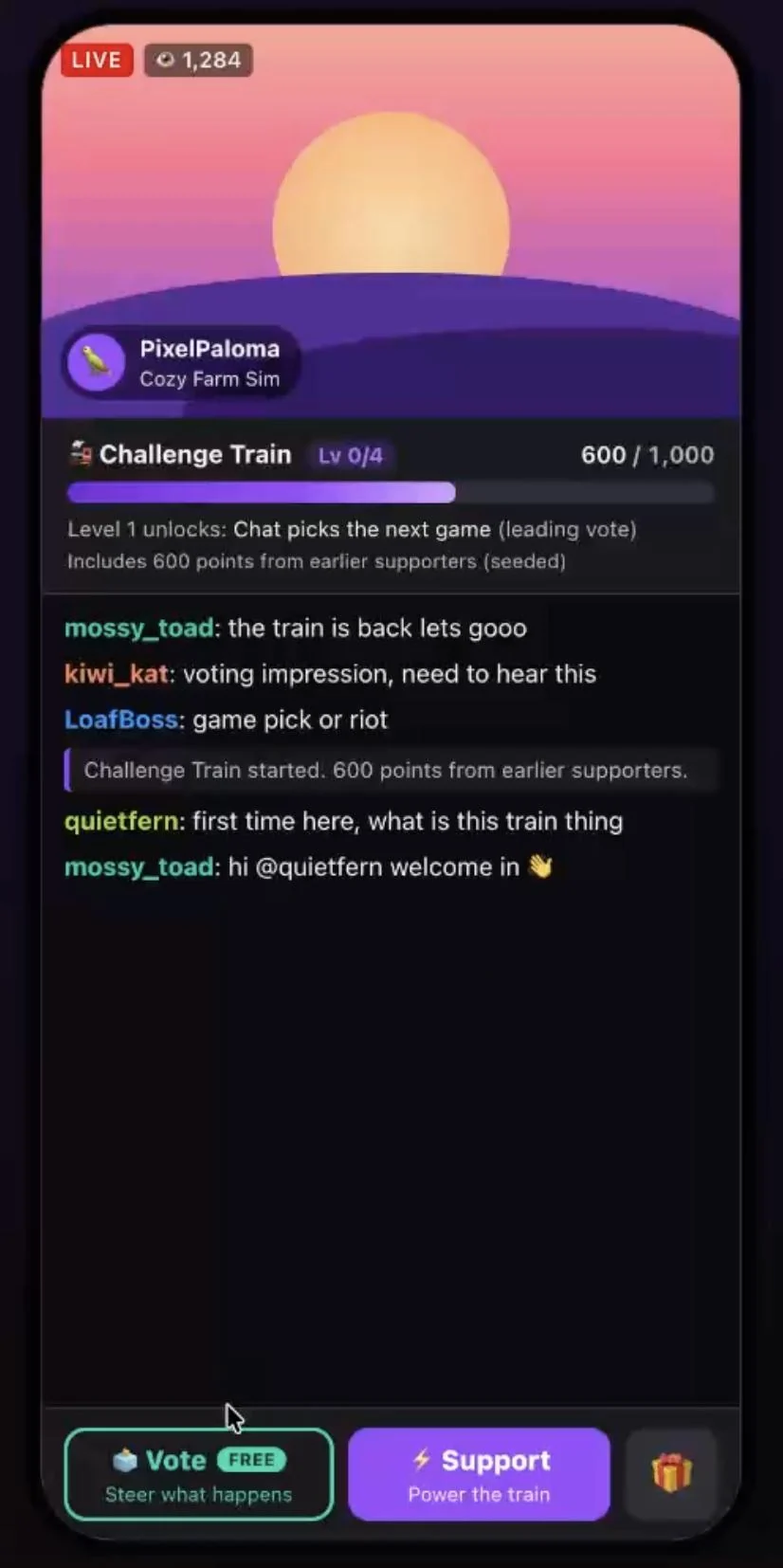
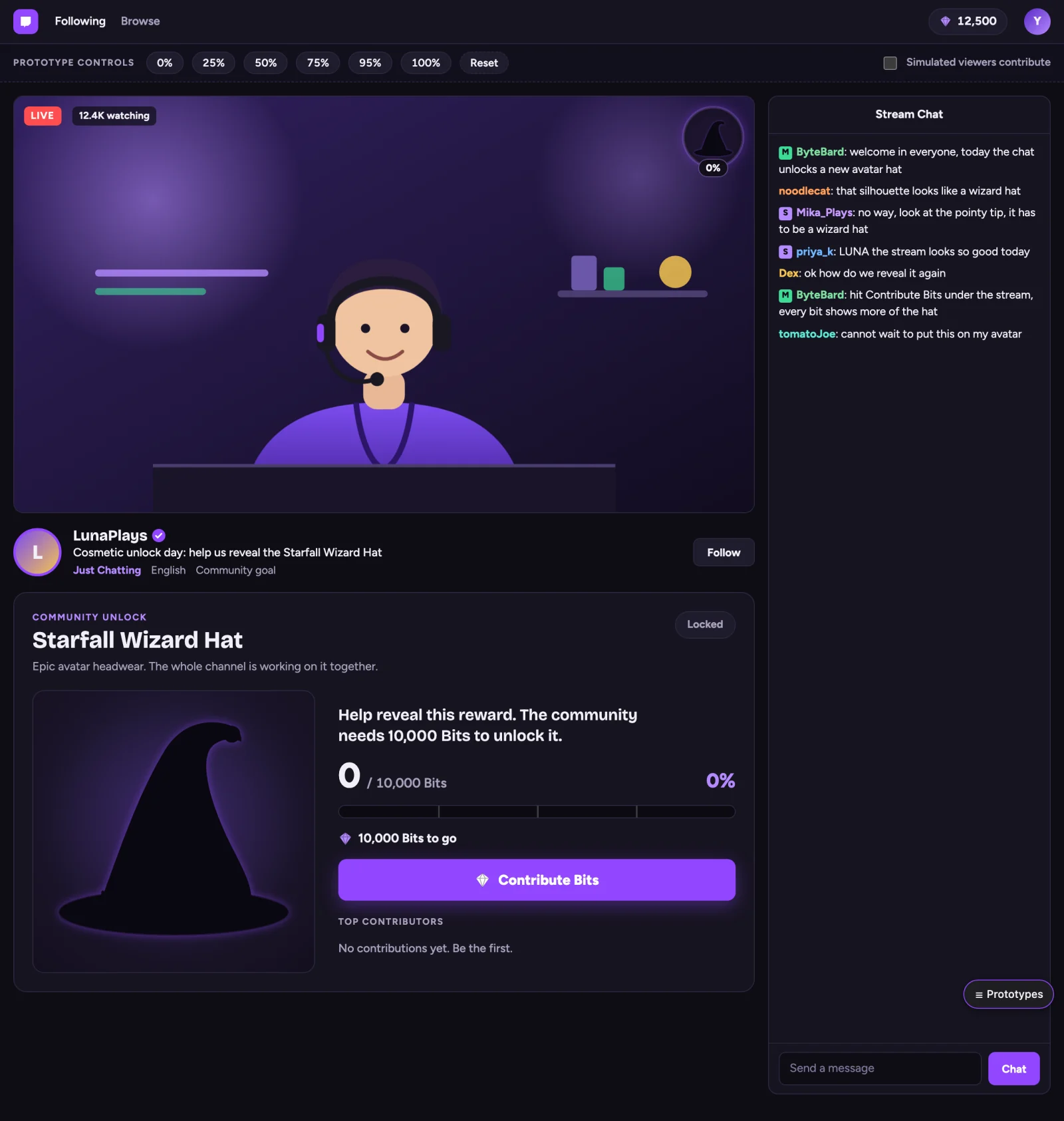
All of them are still live: Battle Boss, Avatar Unlock, Community Reward Run, Hype Pass, and the coded Community Climb Thejas built from the final design. The source is on GitHub.
What my prototype taught me
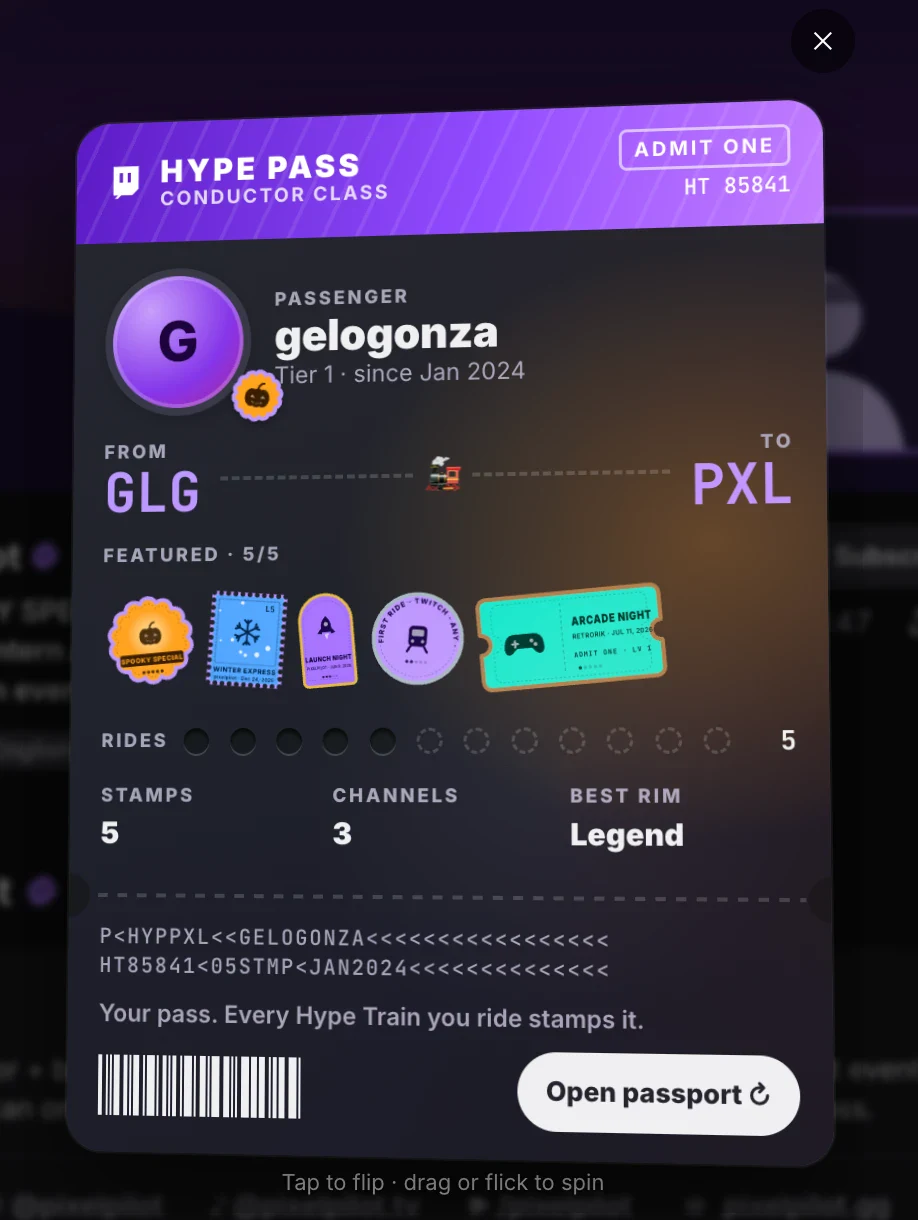
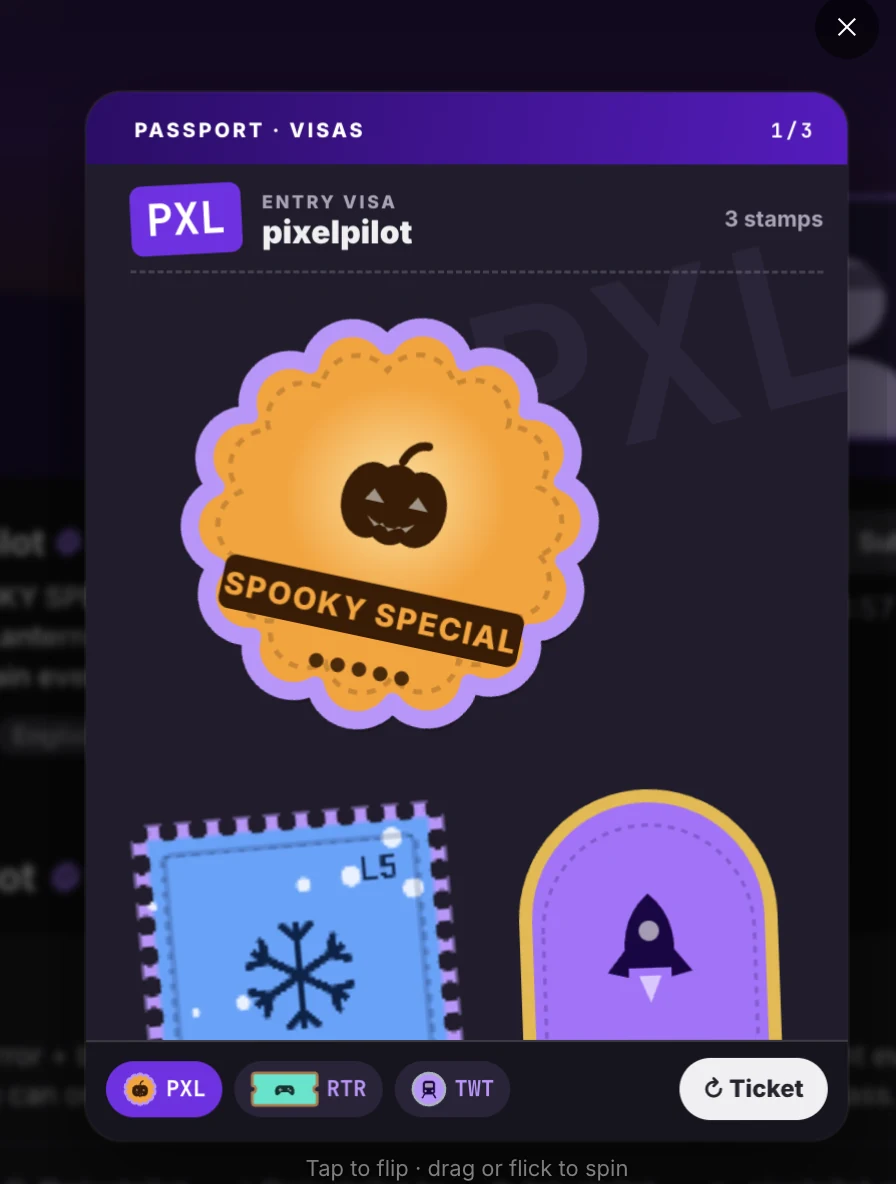
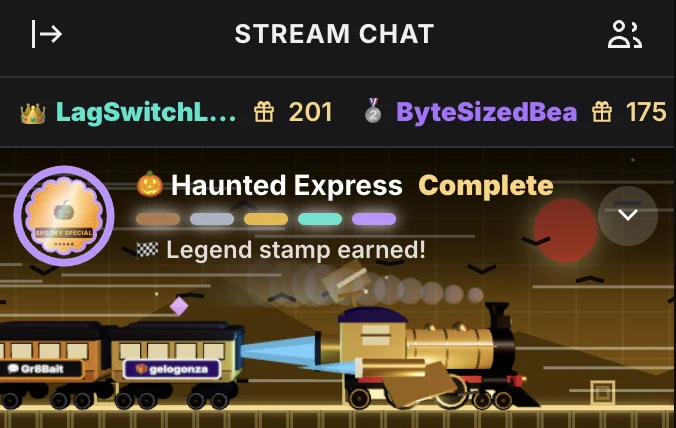
Mine was the Hype Pass, which took the train in Hype Train literally. The train ran above chat as an animated marquee, picking up speed and changing colour as it levelled. Riding it earned you a stamp on your pass, tiered by how much you took part and contributed, and each one was a one of one: only the people on that train could ever hold it. Creators could design their own stamps, and the pass lived on your public profile, so anyone on Twitch who clicked your name saw the trains you had been on. The idea was that a visible record of the moments you shared would give people a reason to keep coming back to a community.
Building it, I realized I had designed the reward stage, not the experience that earns it. Our instructor pushed on exactly that: what would have to happen during a Hype Train for someone to treasure the badge afterward? Rarity on its own does not make anything meaningful.
How the directions came together
On the whiteboard, every concept was checked against the insights it answered, and Challenge Train answered the most. It became the spine: levels the streamer sets, a donor leaderboard, and rewards chosen by the streamer and mods. Minigames were crossed off the same afternoon. The open questions I added that day are what turned it into Community Climb: delegate the work to mods, let fans submit emotes, turn a poll into a challenge, and ask what the community wants to see. Those are the fan-made reward pipeline, and they are my answer to the stamp problem. A reward is worth keeping when someone in chat drew it, about a joke the channel shares, unlocked in a moment everyone watched.
Reflection
What got better since our last project, and what could have been better.
This was the same team's second sprint together, so I could hold it against the one before it.
What improved
We led with the problem. Last time our problem statement arrived a little late. This deck opened on our two questions, and every design decision after them points back to the insight it answers. Our mentor gave the same note on her own: lead with why, use fewer words, show more of the design.
We told it through one person. HarperKeys and her Orb did more work than any diagram. The joke gave the challenges, the mystery goal and the rewards somewhere to come from, and it made the argument for us: a reward is worth more when it belongs to a community.
We converged instead of combining. With four prototypes on the table it would have been easy to keep a piece of each. Checking every piece against the gaps stopped that. Anything that did not answer one came out, which is how the minigames went.
What could have been better
It has not been tested. Our last concept went in front of users and came back with three fixes. This one has not been in front of streamers, and it asks more of them than the Hype Train does. Talking to streamers is the first next step for that reason, and it is what I would want to do before building any of it.
I started from the reward. My own prototype designed what you get before the moment that earns it, and it took building it to see that. Next time I would sketch the experience first and let the reward follow from it, which is the order Community Climb ended up in.